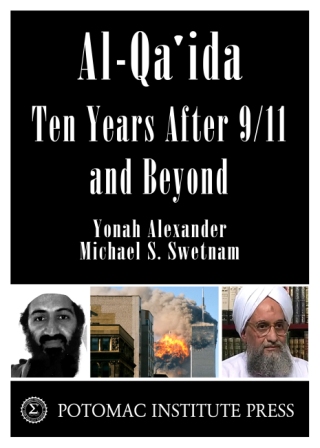
 The Potomac Institute Press is pleased to announce the latest book by Institute Chairman and CEO Michael Swetnam and ICTS Director Prof. Yonah Alexander, Al-Qa'ida: Ten Years After 9/11 and Beyond (Potomac Institute Press, 2012, ISBN: 978-0-9678594-6-0 Paperback, 454 pages). Orders for Al-Qa'ida, Ten Years After and Beyond may be placed through Amazon.com. Click here to access the Amazon listing.
Al-Qa'ida: Ten Years After 9/11 and Beyond follows the authors' 2001 book, Usama bin Laden's al-Qa'ida: Profile of a Terrorist Network, which came out just months before the 9/11 attacks. The new volume offers comprehensive coverage of the group’s history, leadership, financing, propaganda, ideology, and future outlook.
click here to purchase
Here's what prominent scholars are saying about Al-Qa'ida: Ten Years After 9/11 and Beyond:
“This is the indispensable book on al-Qa’ida, its spawn, and its affiliates. Usama and many of his lieutenants have been killed, and the central “base” weakened. But radical Islam and sundry jihadi organizations live. Yonah Alexander and Michael S. Swetnam have been writing about al-Qa’ida since 1988; they have not lost their touch.” Don Wallace, Jr., Professor of Law at Georgetown University and Chairman of the International Law Institute.
“This comprehensive book on al-Qa’ida, its evolution, current status, ideology, modus operandi, and its affiliates provides an excellent source for both experts and those who want to learn about this organization and the challenges posed by international terrorism in general.” Shireen Hunter, Visiting Professor, School of Foreign Service, Georgetown University, and Distinguished Scholar, Center for Strategic and International Studies.
“Few experts on ‘jihadi’ terrorism can write with more authority on the past ten years of al-Qa’ida after 9/11 than Yonah Alexander and his colleague, Michael S. Swetnam. Many things have happened in these ten years; 2011 was an important year just like 2001. To understand what is likely to happen in the future, this book is a must read for both experts and all those interested in world peace.” Honorary Professor Ved Marwah, Centre for Policy Research, New Delhi; Chairman, India’s Task Force on National Security and Criminal Justice System; Former Commissioner of Police Delhi; and Former Governor of Manipur and Jharkhand.
“Many books have been written on al-Qa’ida, but this comprehensive volume details not only the group’s origin and background, but also its evolution into the present. Yonah Alexander and Michael S. Swetnam have produced a much needed, up-to-date handbook on al-Qa’ida and its affiliated groups. An excellent source for all those who study or combat contemporary terrorism.” Michael Fredholm, Senior Researcher, Stockholm International Program for Central Asian Studies (SIPCAS), Stockholm University, Sweden.
“This book, produced from the pens of scholars that have been wrestling with the issues for decades, should come as a timely reminder that we might want to get back to business as usual but that the likes of al-Qa’ida won’t forget us.” William J. Olson, Distinguished Professor, National Defense University.
Authors:
Yonah Alexander, PhD
Director, Inter-University Center for Terrorism Studies
Director, International Center for Terrorism Studies, Potomac Institute for Policy Studies, Arlington, VA, USA
Co-Director, Inter-University Center for Legal Studies at the International Law Institute, Washington, DC, USA
Michael S. Swetnam
CEO and Chairman, Potomac Institute for Policy Studies, Arlington, VA, USA
Member, US Senate Select Committee on Intelligence Technical Advisory Group
Former Special Consultant to the President’s Foreign Intelligence Advisory Board, Washington, DC, USA
Table of Contents:
Introduction by Charles E. Allen
Chapter 1: Ideological and Theological Perspectives
and Goals
Chapter 2: Key Leadership
Chapter 3: Selected Modus Operandi
Chapter 4: Propaganda and Psychological Warfare
Chapter 5: Al-Qai’da’s Key Networks
Chapter 6: Selected Affiliated Groups
Chapter 7: Selected U.S. Individuals with Alleged
al-Qa’ida Connections
Chapter 8: Operation Neptune Spear and Beyond
Appendices
• Selected Electronic Political Communication from
al-Qa’ida (October 2001 – 2011)
• U.S. Indictment of Usama bin Laden (November 5, 1998)
• Remarks by the President on Osama bin Laden
(May 2, 2011)
• Ensuring al-Qa’ida’s Demise (Remarks by John Brennan
on June 29, 2011)
• National Strategy for Counterterrorism (June 2011)
• Empowering Local Partners to Prevent Violent
Extremism in the United States (August 2011)
• The Honorable James R. Clapper, Statement
• David H. Petraeus, Director of CIA, Statement

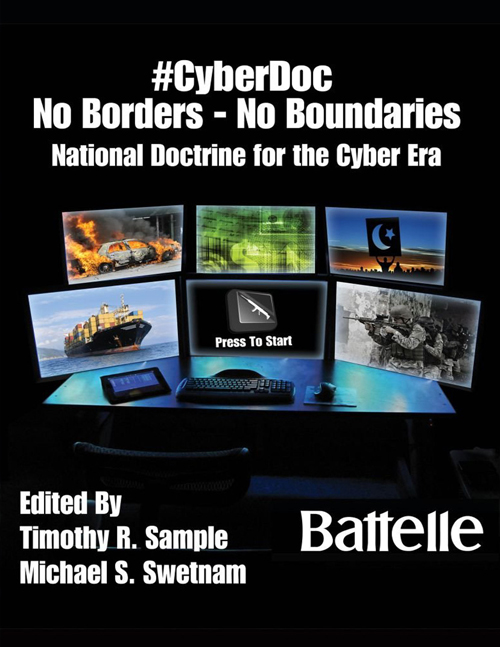
 Co-editors Timothy Sample and Michael Swetnam, along with a dozen thought leaders in the realm of cyber security, have assembled “#CyberDoc: No Borders - No Boundaries” as a preliminary framework for the development of a national doctrine for the cyber era.
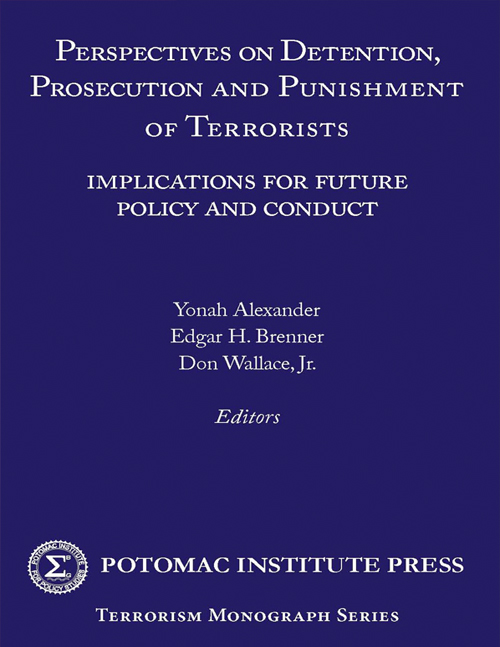
 The Potomac Institute Press is pleased to announce that Perspectives on Detention, Prosecution, and Punishment of Terrorists: Implications for Future Policy and Conduct is now available in a Kindle edition. The new book is the first volume in a series of monographs by the Potomac Institute Press, edited by Prof. Yonah Alexander, PhD, Director of the Institute's International Center for Terrorism Studies, and Profs. Edgar Brenner and Don Wallace.